Project Propose to bring our buried heritage into public debate
Context Student project
Project studio Grands sentiers, Ensa Nantes
Teachers Anne Bossé + Petra Marguc
Place Tougas (44)
Date 2022
Project background
The Grands sentiers led by Anne Bossé, invites you to explore the area on foot, by walking. This action is as much a manifesto as it is a tool for apprehending spaces, enabling us to adopt a posture at the scale of the body in movement. With a strong focus on architectural research on Nantes, the project aims to create a major metropolitan trail by the end of its fourth and final edition in 2024. More information is available in the dedicated Hypothèse booklet https://gdsentiers.hypotheses.org/which compiles the genesis and approach of each project developed, including the Parlement de Tougas but also Reconnecter le Boire de la Coudrouse, my final year project completed in this same studio.
What to do with the 5 million tonnes of rotting waste beneath the Tougas plateau, situated to the west of the Nantes metropolitan area ?
The former landfill site, which opened in 1960 and closed in 1992, is set to make the headlines once again. After 30 years of post-closure monitoring, it has become clear that leachate – highly polluted percolating water –is likely to flow into the Loire in significant quantities within the next five years. Yet solutions already exist. These include remediating the site by treating decomposing waste – a process that has already been carried out on the oldest section – or developing the wet meadows that have been left fallow to capture runoff, treat it and allow it to infiltrate the ground. All of this is possible today but has not been implemented due to a lack of political will and public engagement.We must bring this debate into the public arena so that the implementation of solutions can be discussed.
Here are the issues behind the project to Parlement de Tougaswhich then becomes a manifesto architecture, intended not to be realised as it stands at some point in the future, but to fuel political debate and to visualise this collective issue in space.
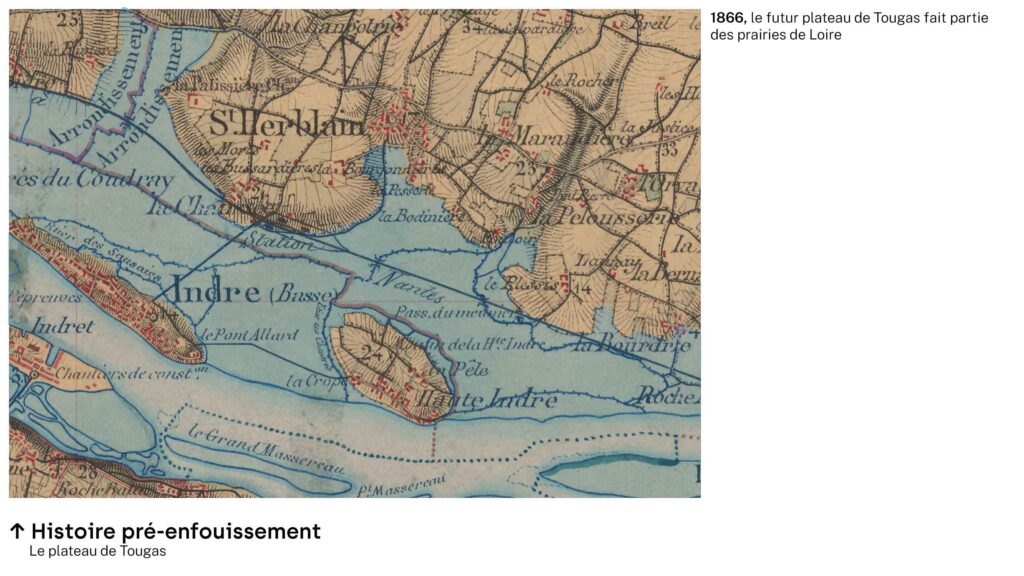
Situated at the very heart of the floodplain of the Loire estuary, the Tougas plain forms part of the Loire grasslands, a brackish tidal area grazed collectively by local farmers.This fluctuation in water salinity and the maintenance of low-growing vegetation provide a wealth of habitats along the estuary. A large number of native species can be found here. These wetlands, rich in biodiversity, were gradually drained by humans at the turn of the 20th century to create more areas of land-based interface with the estuary and its commercial outlet.
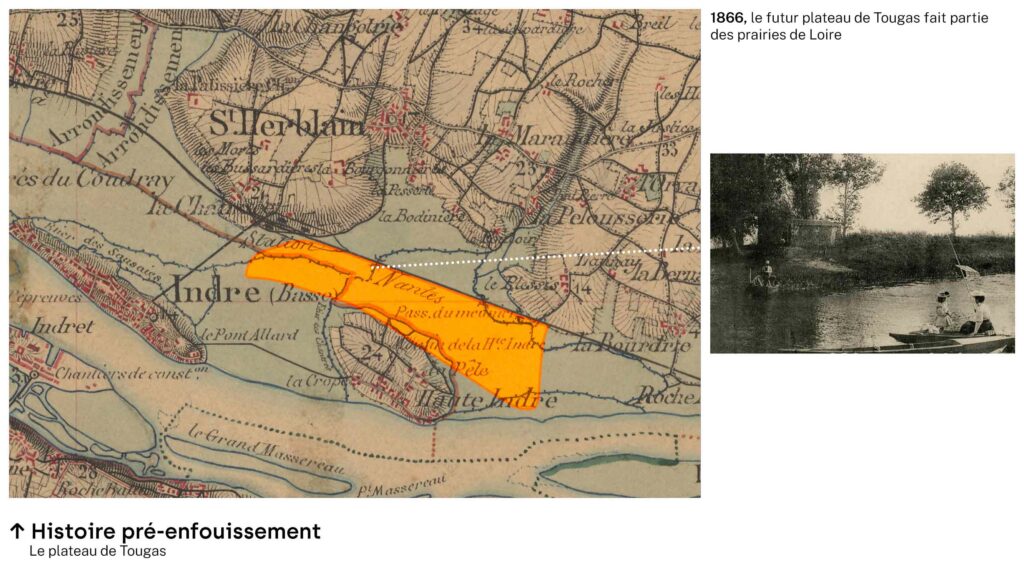
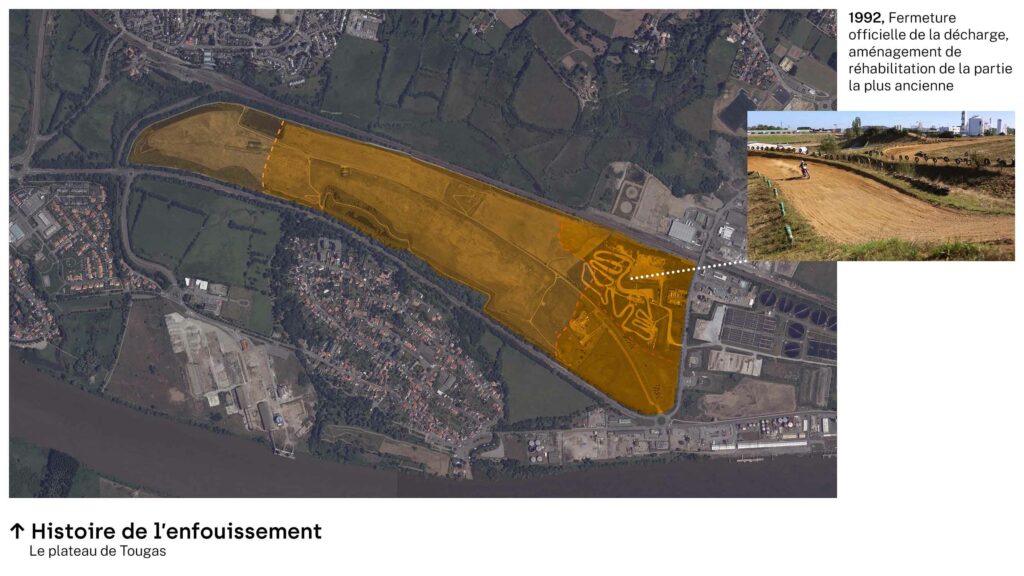
Gradually, an unauthorised landfill site developed and was officially recognised following the purchase of the land by the municipality of Indre in 1960. Waste continued to be deposited there until the landfill site ceased operations in 1992, by which time it contained over 5 million tonnes. The easternmost part of the site was decontaminated and redeveloped into a motocross track, whilst the plateau became the collection area for one of the metropolitan area’s 11 waste collection centres.
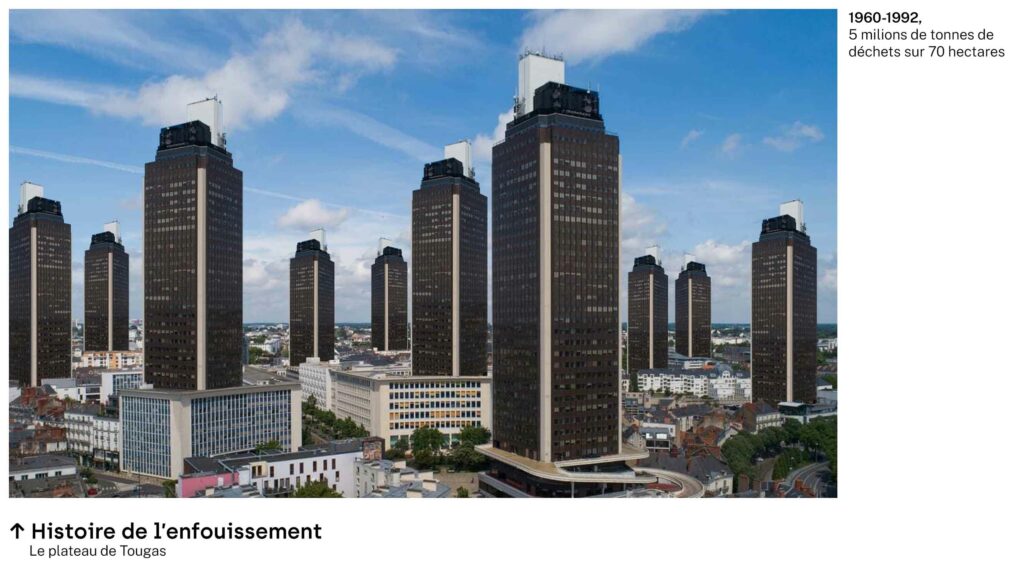
These 700,000 m² of grassland now encompass an area equivalent to around eight ‘Tour Bretagne’ buildings within a floodplain criss-crossed by infrastructure that disrupts the continuity of habitats. This fragmentation is all the more pronounced given that the Tougas plateau – the quintessential man-made barrier – is nonetheless part of the ‘Coulée verte herblinoise’, a network of grasslands, parks and wetlands coordinated across the municipality of St-Herblain.
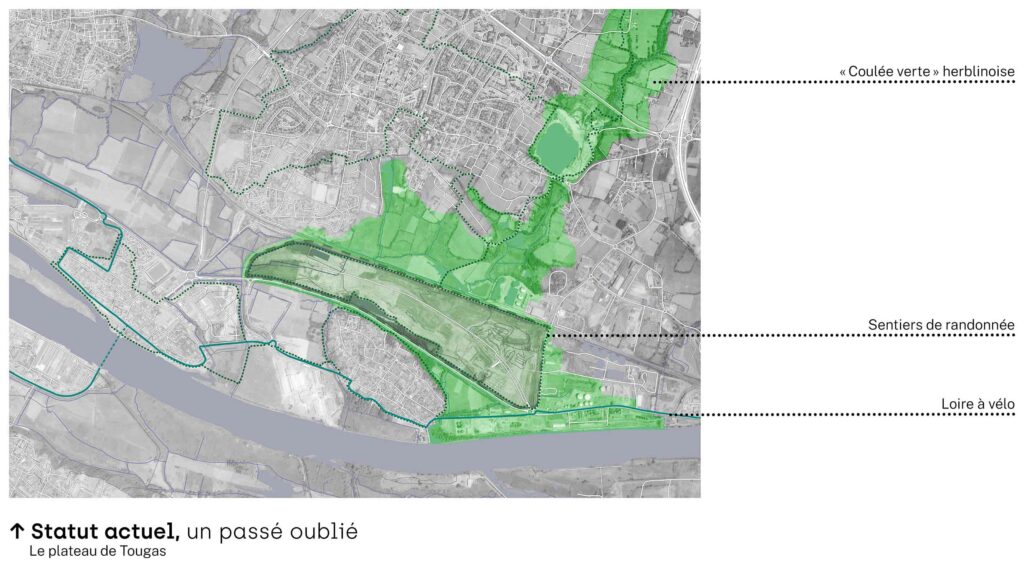
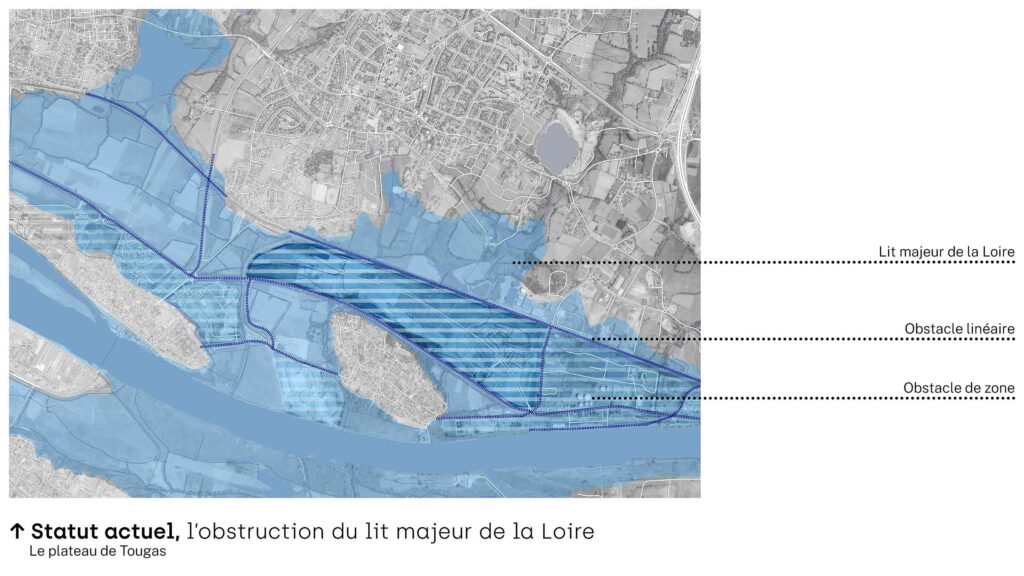
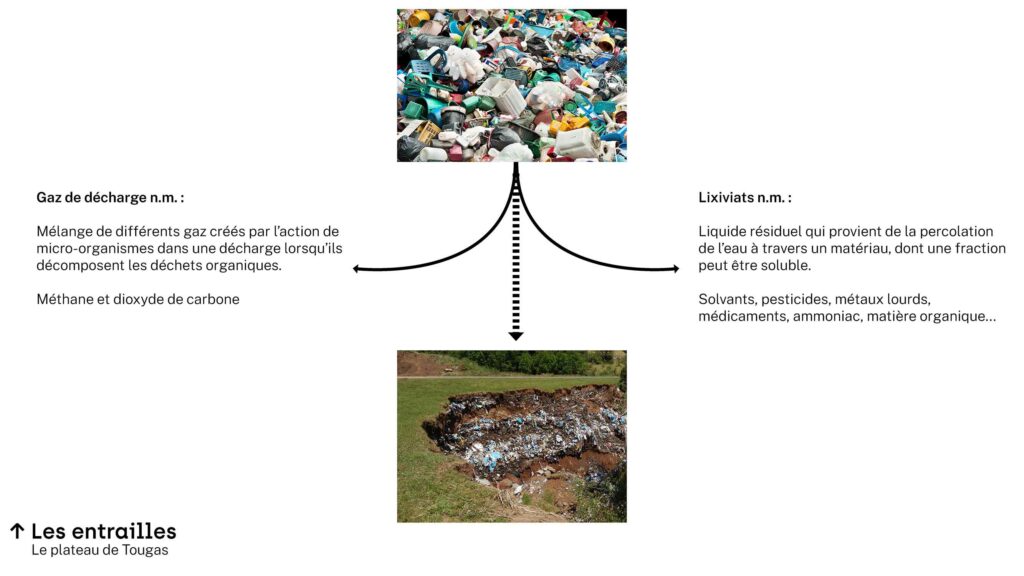
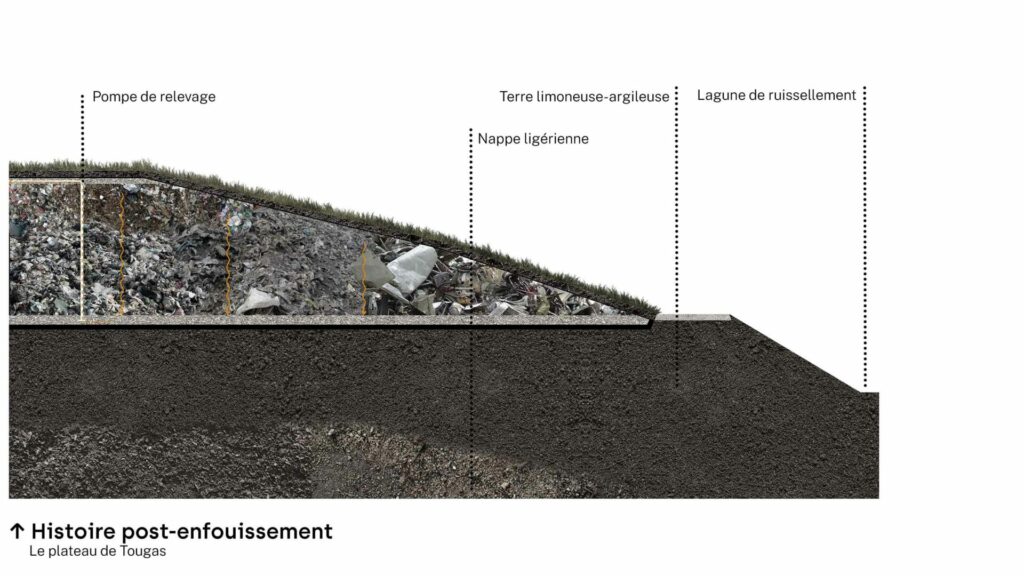
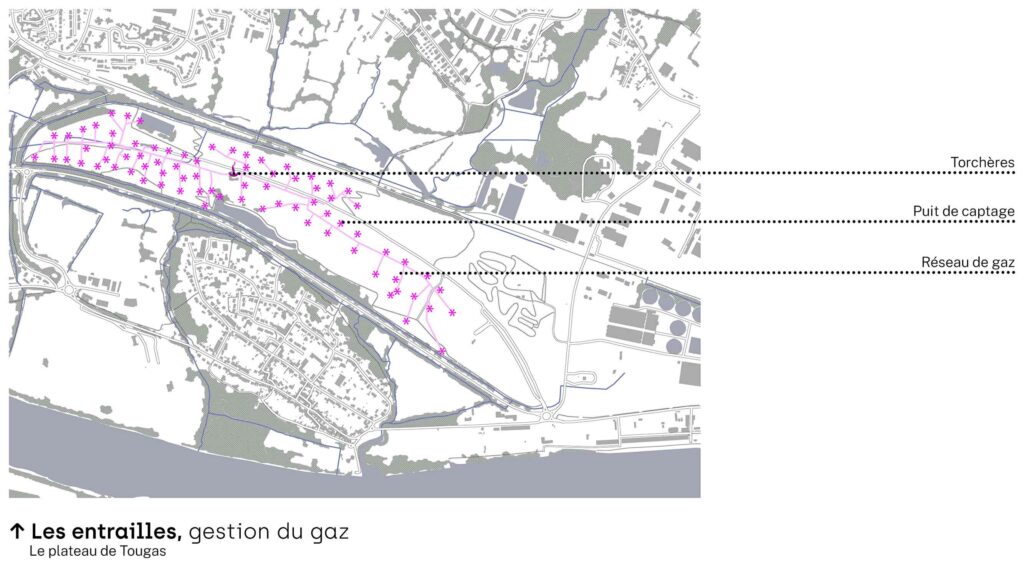
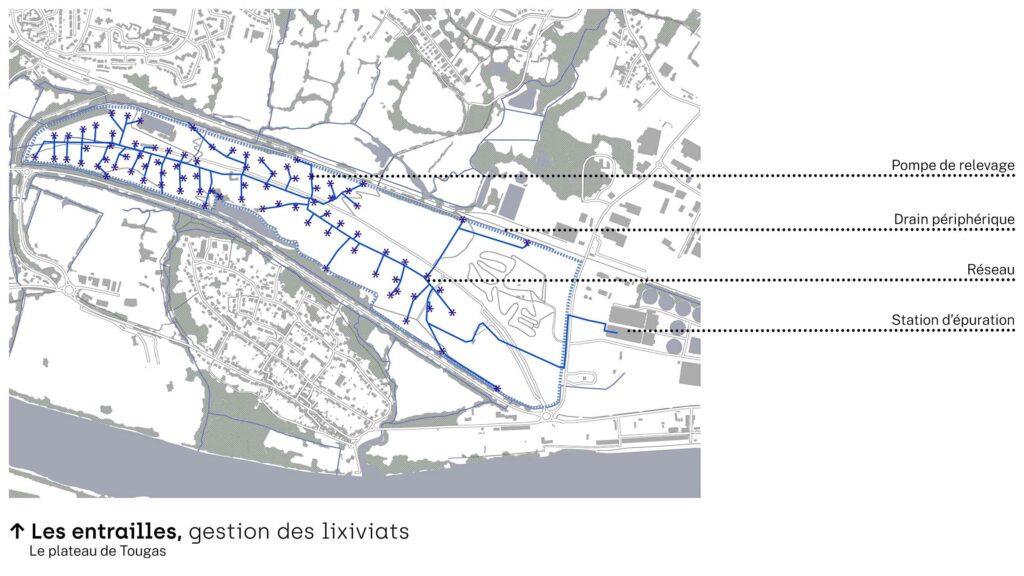
But the Tougas plateau is far from having reverted to its former state as grassland. Hidden beneath the ground are some 78 gas extraction wells and 86 water-lifting pumps used to manage the putrefaction and decomposition of the waste that remains there. These organic and man-made elements, which will remain present for several thousand years, continue to cause pollution in the form of landfill gas – a mixture of methane and carbon dioxide that is particularly prevalent at the start of the decomposition process – but above all in the form of leachate: water that, as it percolates, becomes contaminated with solvents, pesticides, heavy metals, medicines and other soluble substances. If this water is not pumped out and treated promptly, it seeps through the soil and contaminates the groundwater, in this case the Loire aquifer. Here, leaks already exist and have been identified, but it is estimated that they will gradually increase as the geotextile tears.
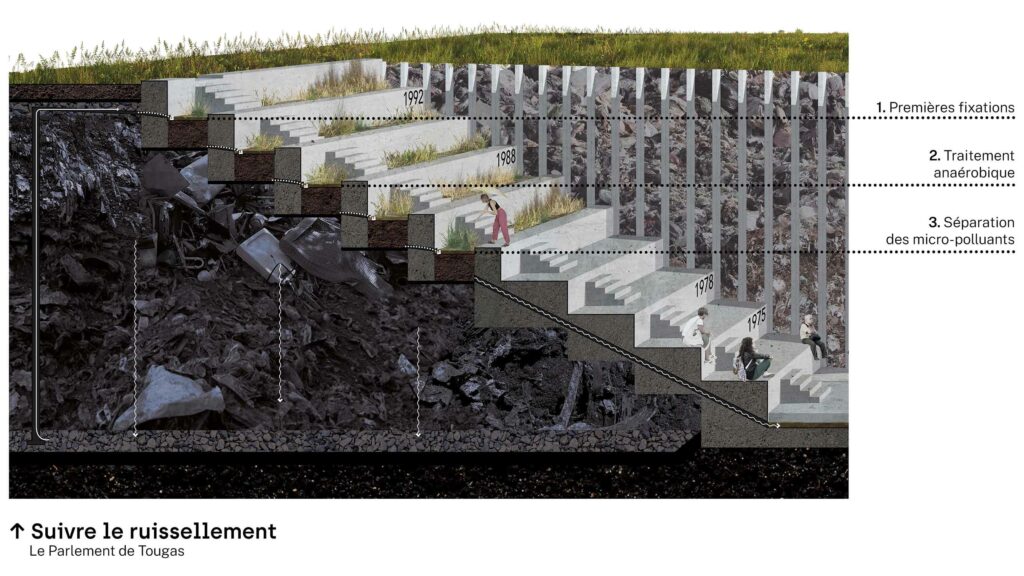
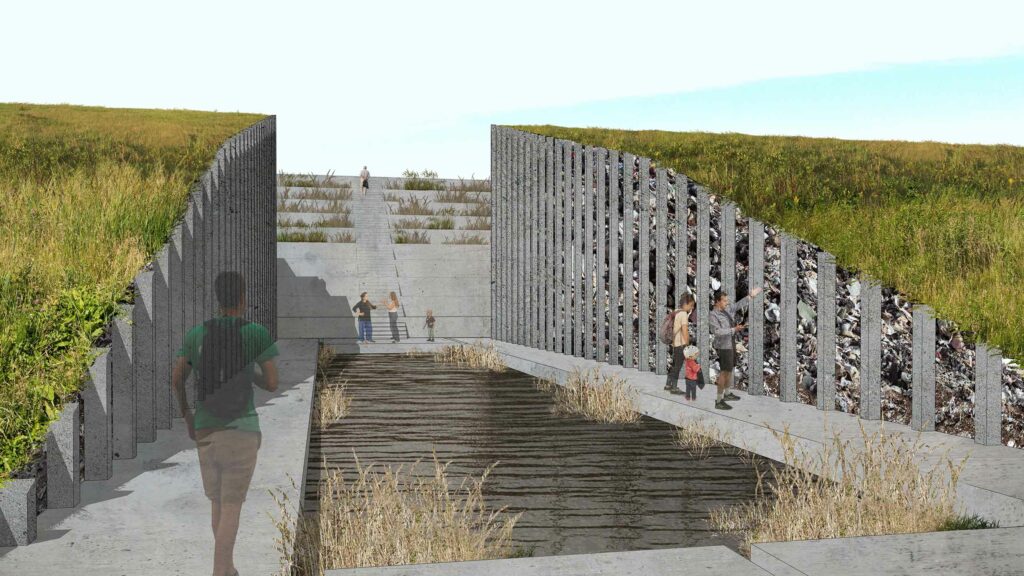
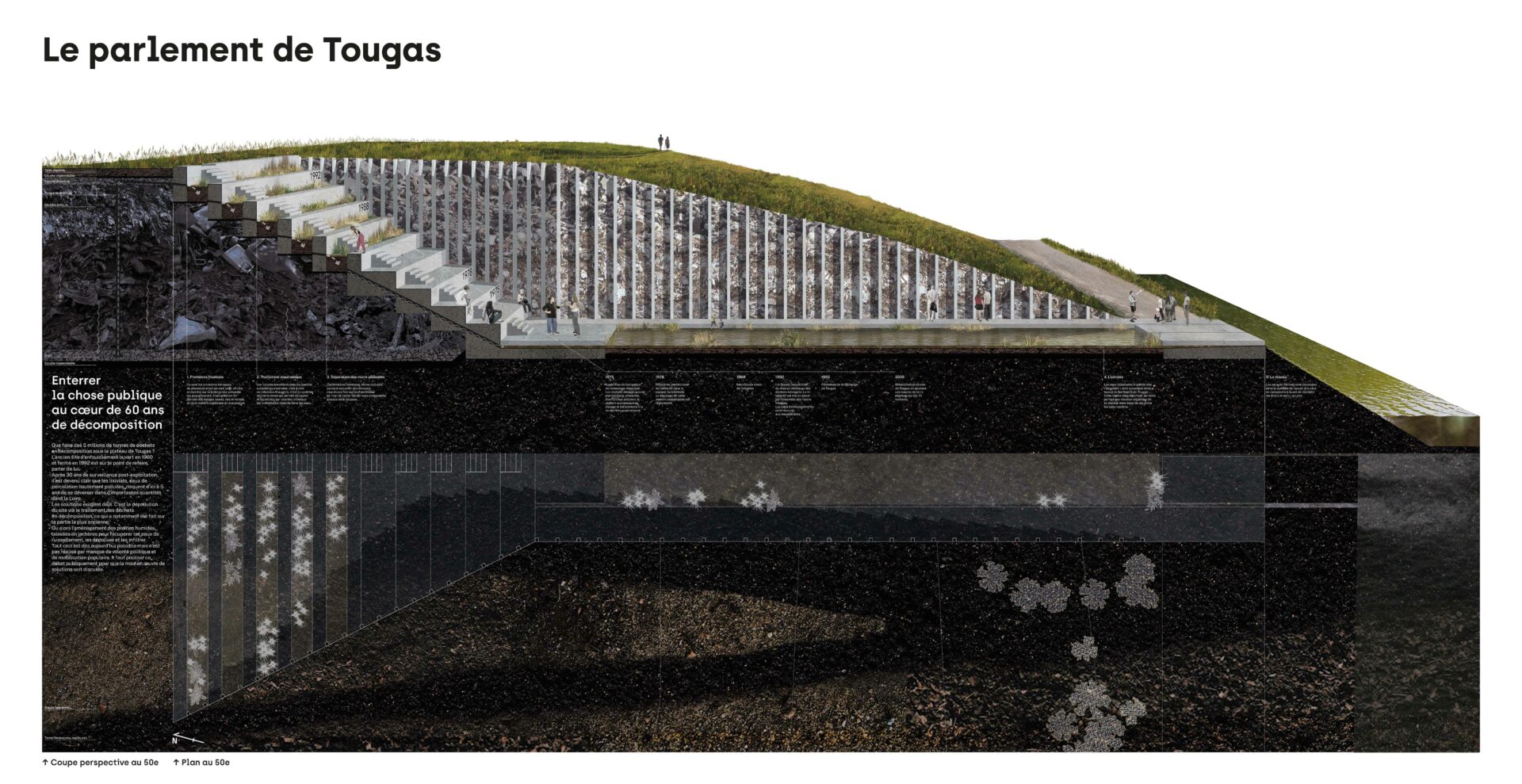
The project of Parlement de Tougas proposes to explore the future of the Tougas plateau by highlighting the chemical and political processes at work on the site. The architecture accommodates the flow of leachate pumped to the surface, which is gradually treated using phytoremediation before being discharged back into the environment. This gravity-fed flow is complemented by a space for collective discussion of Tougas’s future, in the form of an amphitheatre situated amidst the waste.
Conceived as a cut through the plateau, the layout reveals a succession of layers of waste that bear witness to different eras,consumption patterns and methods of managing unwanted materials. The soil is held in place by a system of concrete posts that structure the space, set deep into the ground in the manner of a"paroi berlinoise". The whole structure is stabilised by tie rods anchored directly into the waste soil.
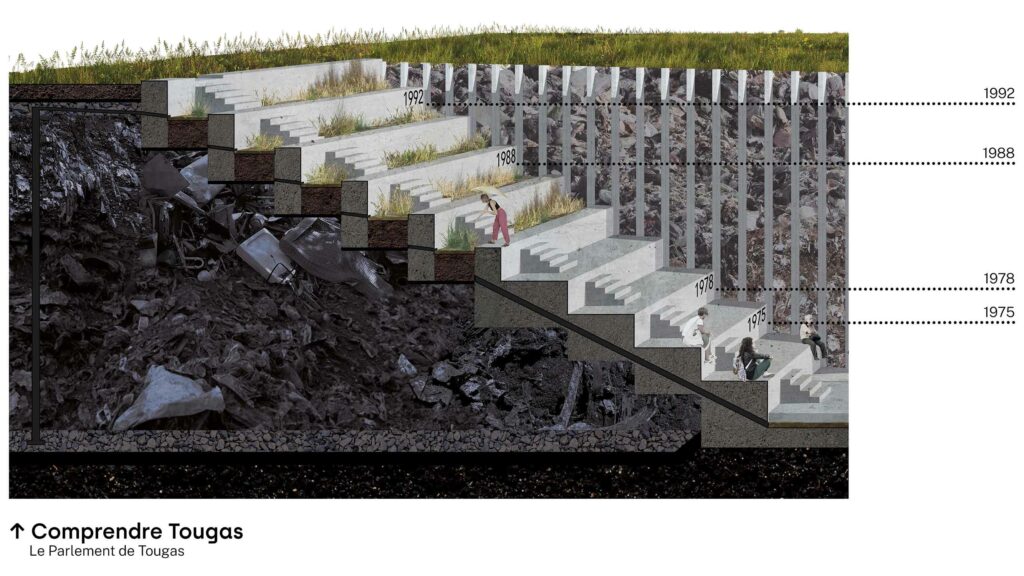
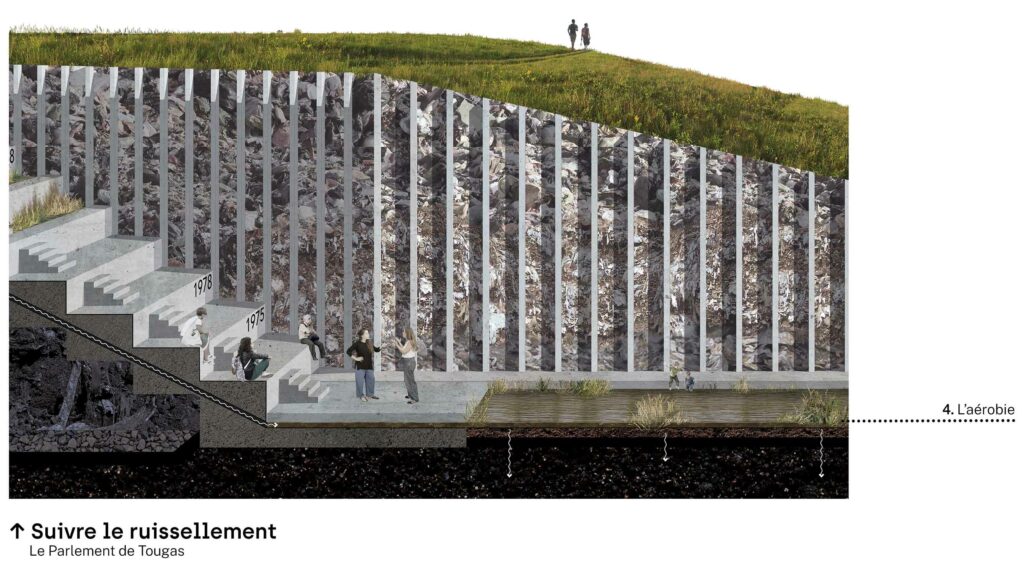
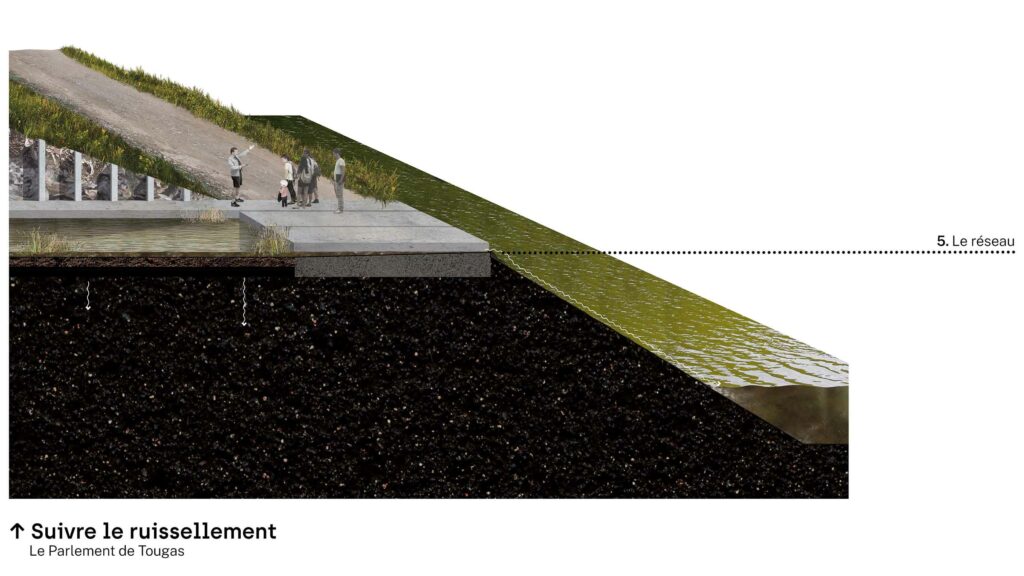
The Parlement de Tougas leads to a body of water created in the channel. This stagnant water allows oxygen-dependent bacteria to proliferate and complete the water treatment process. Finally, at the tip of the device, the water is discharged into the surface water network, joining the nearby water table or estuary.